Showing posts with label all. Show all posts
White fiber of coconut
 The juvenile husks are suspended in a waterway or water-topped pit for off to ten months. Amid this time, small scale living beings separate the plant tissues encompassing the strands to extricate them — a procedure known as retting. Portions of the husk are then beaten by hand to isolate out the long strands which are in this manner dried and cleaned. Cleaned fiber is prepared for turning into yarn utilizing a straightforward one-gave framework or a turning wheel.
Scientists at CSIR's National Institute for Interdisciplinary Science and Technology in Thiruvananthapuram have built up a natural procedure for the extraction of coir fiber from coconut husk without contaminating the earth. The innovation utilizes proteins to isolate the strands by changing over and solubilizing plant mixes to check the contamination of waters caused by retting of husks
White fiber of coconut
0
Brown fibre of coconut

The stringy husks are absorbed pits or in nets in a moderate moving waterway to swell and relax the filaments. The long abound strands are isolated from the shorter sleeping pad filaments underneath the skin of the nut, a procedure known as wet-processing. The sleeping pad strands are filtered to expel soil and other garbage, dried in the sun and stuffed into bunches. Some sleeping cushion fiber is permitted to hold more dampness so it holds its flexibility for turned fiber generation. The coir fiber is sufficiently flexible to wind without breaking and it holds a twist just as for all time waved. Turning is finished by basically making a rope of the hank of fiber and winding it utilizing a machine or by hand. The more drawn out abound fiber is washed in clean water and afterward dried before being tied into groups or hanks. It might then be cleaned and 'hackled' by steel brushes to fix the strands and expel any shorter fiber pieces. Coir swarm fiber can likewise be blanched and colored to get hanks of various hues.
Brown fibre of coconut
0
Preparing of coconut fiber

Green coconuts, collected after around six to a year on the palm, contain malleable white filaments. Dark colored fiber is gotten by collecting completely develop coconuts when the nutritious layer encompassing the seed is prepared to be handled into copra and dried up coconut. The stringy layer of the organic product is then isolated from the hard shell (physically) by driving the natural product down onto a spike to part it (dehusking). An all around prepared husker can physically isolate 2,000 coconuts for each day. Machines are currently accessible which pound the entire natural product to give the free strands. These machines can process up to 2,000 coconuts for every hour.
Preparing of coconut fiber
0
History of coconut fiber

Ropes and cordage have been produced using coconut fiber since old circumstances. Indian guides who cruised the oceans to Malaya, Java, China, and the Gulf of Arabia hundreds of years prior utilized coir for their ship ropes. Bedouin scholars of the eleventh century AD alluded to the broad utilization of coir for dispatch ropes and rigging.[3]
A coir industry in the UK was recorded before the second 50% of the nineteenth century. Amid 1840, Captain Widely, in co-operation with Captain Logan and Mr. Thomas Treloar,[4] established the known cover firms of Treloar and Sons in Ludgate Hill, England, for the fabricate of coir into different textures reasonable for floor coverings.[3]
History of coconut fiber
0
coconut fiber

coconut fiber, is a characteristic fiber separated from the husk of coconut[1] and utilized as a part of items, for example, floor mats, doormats, brushes and sleeping pads. Coir is the sinewy material found between the hard, inner shell and the external layer of a coconut. Different employments of darker coir (produced using ready coconut) are in upholstery cushioning, sacking and cultivation. White coir, collected from unripe coconuts, is utilized for making better brushes, string, rope and angling nets.
coconut fiber
0
Depiction of Banana fiber

The banana plant is the biggest herbaceous blooming plant.[7] All the over the ground parts of a banana plant develop from a structure ordinarily called a "corm".[8] Plants are typically tall and genuinely tough, and are regularly mixed up for trees, however what gives off an impression of being a trunk is really a "false stem" or pseudostem. Bananas develop in a wide assortment of soils, as long as the dirt is no less than 60 cm profound, has great waste and isn't compacted.[9] The leaves of banana plants are made out of a "stalk" (petiole) and a sharp edge (lamina). The base of the petiole extends to shape a sheath; the firmly stuffed sheaths make up the pseudostem, which is every one of that backings the plant. The edges of the sheath meet when it is first delivered, making it tubular. As new development happens in the focal point of the pseudostem the edges are constrained apart.[10] Cultivated banana plants shift in tallness relying upon the assortment and developing conditions. Most are around 5 m (16 ft) tall, with a range from 'Diminutive person Cavendish' plants at around 3 m (10 ft) to 'Gros Michel' at 7 m (23 ft) or more.[11][12] Leaves are spirally masterminded and may grow 2.7 meters (8.9 ft) long and 60 cm (2.0 ft) wide.[1] They are effortlessly torn by the breeze, bringing about the well-known frond look.[13]
At the point when a banana plant is develop, the corm quits delivering new leaves and starts to shape a blossom spike or inflorescence. A stem creates which grows up inside the pseudostem, conveying the youthful inflorescence until inevitably it rises at the top.[14] Each pseudostem typically delivers a solitary inflorescence, otherwise called the "banana heart". (More are some of the time delivered; an excellent plant in the Philippines created five.[15]) After fruiting, the pseudostem bites the dust, yet branches will typically have created from the base, so the plant all in all is perpetual. In the estate arrangement of development, just a single of the branches will be permitted to create keeping in mind the end goal to keep up spacing.[16] The inflorescence contains numerous bracts (here and there mistakenly alluded to as petals) between columns of blossoms. The female blossoms (which can form into natural product) show up in columns additionally up the stem (nearer to the leaves) from the lines of male blooms. The ovary is second rate, implying that the little petals and other blossom parts show up at the tip of the ovary.[17]
The banana natural products create from the banana heart, in a huge hanging bunch, made up of levels (called "hands"), with up to 20 organic product to a level. The hanging group is known as a pack, including 3– 20 levels, or financially as a "banana stem", and can weigh 30– 50 kilograms (66– 110 lb). Singular banana natural products (usually known as a banana or "finger") normal 125 grams (0.276 lb), of which around 75% is water and 25% dry issue (supplement table, bring down right).
The organic product has been portrayed as a "rough berry".[18] There is a defensive external layer (a peel or skin) with various long, thin strings (the phloembundles), which run longwise between the skin and the eatable internal part. The inward piece of the basic yellow treat assortment can be part longwise into three areas that relate to the internal segments of the three carpels by physically disfiguring the unopened fruit.[19] In developed assortments, the seeds are decreased almost to non-presence; their leftovers are small dark spots in the inside of the fruit.[20]
Bananas are normally marginally radioactive,[21] more so than most different organic products, on account of their potassium content and the little measures of the isotope potassium-40 found in normally happening potassium.[22] The banana equal dosage of radiation is once in a while utilized as a part of atomic correspondence to think about radiation levels and exposures.[23]
Depiction of Banana fiber
0
Banana fiber

The banana is a consumable natural product – organically a berry[1][2] – created by a few sorts of vast herbaceous blossoming plants in the genusMusa.[3] In a few nations, bananas utilized for cooking might be called plantains, as opposed to dessert bananas. The natural product is variable in size, shading, and solidness, however is typically lengthened and bended, with delicate substance rich in starch secured with a skin, which might be green, yellow, red, purple, or dark colored when ready. The organic products develop in groups dangling from the highest point of the plant. All cutting edge palatable parthenocarpic (seedless) bananas originate from two wild species – Musa acuminata and Musa balbisiana. The logical names of most developed bananas are Musa acuminata, Musa balbisiana, and Musa × paradisiaca for the half and half Musa acuminata × M. balbisiana, contingent upon their genomicconstitution. The old logical name Musa sapientum is never again utilized.
Musa species are local to tropical Indomalaya and Australia, and are probably going to have been first trained in Papua New Guinea.[4][5] They are developed in 135 countries,[6] essentially for their natural product, and to a lesser degree to make fiber, banana wine, and banana lager and as fancy plants.
Around the world, there is no sharp refinement amongst "bananas" and "plantains". Particularly in the Americas and Europe, "banana" more often than not alludes to delicate, sweet, dessert bananas, especially those of the Cavendish gathering, which are the principle trades from banana-developing nations. By differentiate, Musa cultivars with firmer, starchier natural product are called "plantains". In different districts, for example, Southeast Asia, numerous more sorts of banana are developed and eaten, so the paired qualification isn't valuable and isn't made in neighborhood dialects.
The expression "banana" is likewise utilized as the regular name for the plants that deliver the fruit.[3] This can reach out to different individuals from the sort Musa, for example, the red banana (Musa coccinea), the pink banana (Musa velutina), and the Fe'i bananas. It can likewise allude to individuals from the class Ensete, for example, the snow banana (Ensete glaucum) and the financially imperative false banana (Ensete ventricosum). The two genera are in the banana family, Musaceae.
Banana fiber
0
Mass flowering of bamboo fiber

Bamboos occasionally and unusually blossom, and the recurrence of blooming fluctuates enormously from species to species. When blossoming happens, a plant decreases and frequently kicks the bucket completely. Indeed, numerous species just bloom at interims as long as 65 or 120 years. These taxa show mass blooming (or gregarious blossoming), with all plants in a specific 'partner' blooming over a few year .time span Any plant got through clonal spread from this companion will likewise bloom paying little heed to whether it has been planted in an alternate area. The longest mass blossoming interim known is 130 years, and it is for the species Phyllostachys bambusoides (Sieb. and Zucc.). In this species, all plants of a similar stock bloom in the meantime, paying little heed to contrasts in geographic areas or climatic conditions, and afterward the bamboo kicks the bucket. The absence of ecological effect on the season of blossoming demonstrates the nearness or something to that affect of "wake up timer" in every phone of the plant which flags the redirection of all vitality to bloom generation and the end of vegetative growth.[19] This system, and also the developmental reason behind it, is still to a great extent a puzzle.
One speculation to clarify the development of this semelparous mass blossoming is the predator satiation theory, which contends that by fruiting in the meantime, a populace expands the survival rate of its seeds by flooding the region with natural product, so regardless of the possibility that predators eat their fill, seeds will even now be left finished. By having a blossoming cycle longer than the life expectancy of the rat predators, bamboos can control creature populaces by causing starvation amid the period between blooming occasions. In this way, the passing of the grown-up clone is because of asset depletion, as it would be more successful for parent plants to dedicate all assets to making an extensive seed edit than to keep down vitality for their own regeneration.[20]
Another, the fire cycle theory, expresses that intermittent blooming took after by death of the grown-up plants has developed as an instrument to make unsettling influence in the living space, hence furnishing the seedlings with a hole in which to develop. This contends the dead culms make an extensive fuel stack, and furthermore a vast focus for lightning strikes, improving the probability of wildfire.[21] Because bamboos can be forceful as early successional plants, the seedlings would have the capacity to overwhelm different plants and assume control over the space left by their folks.
In any case, both have been questioned for various reasons. The predator satiation speculation does not clarify why the blossoming cycle is 10 times longer than the life expectancy of the neighborhood rodents, something not anticipated. The bamboo fire cycle speculation is considered by a couple of researchers to be preposterous; they argue[22] that flames just outcome from people and there is no common fire in India. This thought is viewed as wrong in light of conveyance of lightning strike information amid the dry season all through India. Be that as it may, another contention against this is the absence of point of reference for any living life form to bridle something as flighty as lightning strikes to expand its shot of survival as a feature of common developmental progress.[23]
All the more as of late, a scientific clarification for the outrageous length of the blossoming cycles has been offered, including both the balancing out determination inferred by the predator satiation speculation and others, and the way that plants that bloom at longer interims tend to discharge more seeds.[24][25] The theory guarantees that bamboo blossoming interims developed by integermultiplication. A mutant bamboo plant blooming at a noninteger different of its populace's blossoming interim would discharge its seeds alone, and would not appreciate the advantages of aggregate blooming, (for example, insurance from predators). Be that as it may, a mutant bamboo plant blossoming at a whole number various of its populace's blooming interim would discharge its seeds just amid aggregate blossoming occasions, and would discharge a bigger number of seeds than the normal plant in the populace. It could, along these lines, assume control over the populace, building up a blossoming interim that is a whole number numerous of the past blooming interim. The speculation predicts that watched bamboo blooming interims ought to factorize into little prime numbers.
The mass fruiting likewise has coordinate monetary and environmental results, notwithstanding. The immense increment in accessible organic product in the timberlands regularly causes a blast in rat populaces, prompting increments in ailment and starvation in adjacent human populaces. For instance, obliterating outcomes happen when the Melocanna bambusoides populace blooms and natural products once every 30– 35 years[26] around the Bay of Bengal. The passing of the bamboo plants following their fruiting means the nearby individuals lose their building material, and the huge increment in bamboo organic product prompts a fast increment in rat populaces. As the quantity of rodents expands, they devour all accessible sustenance, including grain fields and put away nourishment, once in a while prompting starvation. These rats can likewise convey risky maladies, for example, typhus, typhoid, and bubonic torment, which can achieve pestilence extents as the rodents increment in number.[19][20] The connection between rodent populaces and bamboo blooming was inspected in a 2009 Nova narrative "Rodent Attack".
Regardless, blossoming produces masses of seeds, commonly suspended from the finishes of the branches. These seeds offer ascent to another age of plants that might be indistinguishable in appearance to those that went before the blooming, or they may deliver new cultivars with various qualities, for example, the nearness or nonappearance of striping or different changes in shading of the culms.
A few bamboo animal groups are never known to set seed notwithstanding when sporadically blossoming has been accounted for. Bambusa vulgaris, Bambusa balcooa, and Dendrocalamus stocksii are normal cases of such bamboo
Mass flowering of bamboo fiber
0
Ecology of bamboo fiber

The two general examples for the development of bamboo are "bunching" (sympodial) and "running" (monopodial). Clustering bamboo species tend to spread gradually, as the development example of the rhizomes is to just grow the root mass slowly, like elaborate grasses. "Running" bamboos, however, should be controlled amid development in light of their potential for forceful conduct. They spread mostly through their rhizomes, which can spread broadly underground and send up new culms to get through the surface. Running bamboo species are exceedingly factor in their inclination to spread; this is identified with both the species and the dirt and atmosphere conditions. Some can convey sprinters of a few meters every year, while others can remain in a similar general region for long stretches. In the event that dismissed, after some time, they can cause issues by moving into adjoining zones.
Bamboos incorporate a portion of the quickest developing plants on Earth, with announced development rates up to 91 cm (36 in) in 24 hours.[5] However, the development rate is subject to nearby soil and climatic conditions, and in addition species, and a more average development rate for some usually developed bamboos in calm atmospheres is in the scope of 3– 10 cm (1.2– 3.9 in) every day amid the developing time frame. Essentially developing in districts of hotter atmospheres amid the late Cretaceous time frame, immense fields existed in what is presently Asia. A portion of the biggest timber bamboo can develop more than 30 m (98 ft) tall, and be as extensive as 25– 30 cm (9.8– 11.8 in) in breadth. Be that as it may, the size range for develop bamboo is species-subordinate, with the littlest bamboos achieving just a few inches high at development. A run of the mill stature go that would cover a significant number of the basic bamboos developed in the United States is 4.5– 12 m (15– 39 ft), contingent upon species. Anji County of China, known as the "Town of Bamboo", gives the ideal atmosphere and soil conditions to develop, reap, and process probably the most esteemed bamboo posts accessible around the world.
Not at all like all trees, singular bamboo culms rise up out of the ground at their full breadth and develop to their full tallness in a solitary developing period of three to four months. Amid this time, each new shoot develops vertically into a culm with no spreading out until the point when most of the develop tallness is come to. At that point, the branches stretch out from the hubs and leafing out happens. In the following year, the thick mass of every culm gradually solidifies. Amid the third year, the culm solidifies further. The shoot is presently a completely develop culm. Throughout the following 2– 5 years (contingent upon species), organism starts to frame outwardly of the culm, which in the long run enters and beats the culm.[citation needed] Around 5– 8 years after the fact (species-and atmosphere subordinate), the parasitic developments make the culm crumple and rot. This short life implies culms are prepared for reap and appropriate for use in development inside around three to seven years. Singular bamboo culms don't get any taller or bigger in breadth in consequent years than they do in their first year, and they don't supplant any development lost from pruning or characteristic breakage. Bamboo has an extensive variety of strength relying upon species and area. Little or youthful examples of an individual species deliver little culms at first. As the cluster and its rhizome framework develop, taller and bigger culms are delivered every year until the point when the plant approaches its specific species cutoff points of stature and distance across.
Numerous tropical bamboo species pass on at or close solidifying temperatures, while a portion of the hardier mild bamboos can survive temperatures as low as −29 °C (−20 °F). A portion of the hardiest bamboo species can be developed in USDA plant solidness zone 5, despite the fact that they commonly defoliate and may even lose all over the ground development, yet the rhizomes survive and send up shoots again the following spring. In milder atmospheres, for example, USDA zone 7 or more, most bamboo remain completely leafed out and green year-round.
Ecology of bamboo fiber
0
Dissemination of bamboo fiber

Most bamboo species are local to warm and wet tropical and warm mild climates.[11] However, numerous species are found in assorted atmospheres, going from hot tropical districts to cool rocky areas and good country cloud timberlands. In the Asia-Pacific locale they happen crosswise over East Asia, from 50 °N scope in Sakhalin[12] south to Northern Australia, and west to India and the Himalayas. China, Japan, Korea, India, and Australia, all have a few endemic populations.[13] They additionally happen in little numbers in sub-Saharan Africa, kept to tropical regions, from southern Senegal in the north to southern Mozambique and Madagascar in the south.[14] In the Americas, bamboo has a local range from 47 °S in southern Argentina and the beech timberlands of focal Chile, through the South American tropical rainforests, to the Andesin Ecuador almost 4,300 m (14,000 ft). Bamboo is likewise local through Central America and Mexico, northward into the Southeastern United States.[15] Canada and mainland Europe are not known to have any local types of bamboo.[16] As garden plants, numerous species become promptly outside these extents, including the majority of Europe and the United States.
As of late, a few endeavors have been made to develop bamboo on a business premise in the Great Lakes area of east-focal Africa, particularly in Rwanda.[17] In the United States, a few organizations are developing, gathering, and disseminating species, for example, Phyllostachys nigra (Henon) and Phyllostachys edulis (Moso).[
Dissemination of bamboo fiber
0
Bamboo fiber

The bamboos are evergreen perpetual blossoming plants in the subfamily Bambusoideae of the grass family Poaceae. In bamboo, as in different grasses, the internodal areas of the stem are normally empty and the vascular packages in the cross segment are scattered all through the stem rather than in a round and hollow course of action. The dicotyledonous woody xylem is likewise missing. The nonattendance of optional development wood causes the stems of monocots, including the palms and huge bamboos, to be columnar as opposed to tapering.[3]
Bamboos incorporate a portion of the quickest developing plants in the world,[4] because of a one of a kind rhizome-subordinate framework. Certain types of bamboo can grow 91 cm (36 in) inside a 24-hour time span, at a rate of right around 4 cm (1.6 in) 60 minutes (a development around 1 mm at regular intervals, or 1 inch each 40 minutes).[5] Giant bamboos are the biggest individuals from the grass family. Bamboos are of prominent financial and social centrality in South Asia, Southeast Asia and East Asia, being utilized for building materials, as a nourishment source, and as a flexible crude item. Bamboo has a higher particular compressive quality than wood, block, or concrete and a particular rigidity that adversaries steel.[6][7]
The word bamboo originates from the Kannada expression bambu, which was acquainted with English through Indonesian and Malay
Bamboo fiber
0
Rayon fiber
Rayon or fake silk is a made recovered cellulose fiber.
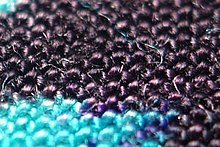
It is produced using cleaned cellulose, essentially from wood mash, which is artificially changed over into a solvent compound. It is then disintegrated and constrained through a spinneret to deliver fibers which are artificially set, bringing about engineered strands of almost unadulterated cellulose.[1]
Laborers can be genuinely hurt by the carbon disulfide used to make generally rayon.[2][3]
Since rayon is fabricated from normally happening polymers, it is viewed as a semi-engineered fiber.[4] Specific sorts of rayon incorporate thick, modular and lyocell, each of which varies in assembling procedure and properties of the completed item.
Rayon fiber
0
Development of abaca fiber

The plant is regularly developed in all around depleted loamy soil, utilizing rhizomes planted toward the begin of the blustery season.[10] what's more, new plants can be begun by seeds.[21] Growers reap abacá handle each three to eight months after an underlying development time of 12– 25 months.[4][10] Harvesting is finished by evacuating the leaf-stems subsequent to blooming yet before organic product appears.[4] The plant loses efficiency in the vicinity of 15 and 40 years.[4] The slants of volcanoes give a favored developing environment.[15] Harvesting for the most part incorporates a few operations including the leaf sheaths:
tuxying (partition of essential and auxiliary sheath)
stripping (getting the strands)
drying (normally following the custom of sun-drying).
At the point when the handling is finished, the groups of fiber are pale and shiny with a length of 6– 12 feet (1.8– 3.7 m).[21]
In Costa Rica, more present day reap and drying strategies are being created to oblige the exceptional returns got there.
As indicated by the Philippine Fiber Industry Development Authority, the Philippines gave 87.4% of the world's abaca in 2014, gaining the Philippines US$111.33 million.[22] The request is as yet more noteworthy than the supply.[22] The rest of from Ecuador (12.5%) and Costa Rica (0.1%).[22] The Bicol district in the Philippines delivered 27,885 metric huge amounts of abaca in 2014, the biggest of any Philippine region.[22] The Philippine Rural Development Program (PRDP) and the Department of Agriculture detailed that in 2009-2013, Bicol Region had 39% offer of Philippine abaca producution while overpowering 92% originates from Catanduanes Island. Eastern Visayas, the second biggest maker had 24% and the Davao Region, the third biggest maker had 11% of the aggregate generation. Around 42 percent of the aggregate abaca fiber shipments from the Philippines went to the United Kingdom in 2014, making it the best importer.[22] Germany imported 37.1 percent abaca mash from the Philippines, bringing in around 7,755 metric tons (MT).[22] Sales of abaca cordage surged 20 percent in 2014 to a sum of 5,093 MT from 4,240 MT, with the United States holding around 68 percent of the market.
Development of abaca fiber
0
Textiles of abaca fiber

The internal filaments are utilized as a part of the making of caps, including the "Manila caps," lofts, tangling, cordage, ropes, coarse twines, and sorts of canvas. It is called Manila hemp in the market in spite of the fact that it is dissimilar to genuine hemp, and is otherwise called Cebu hemp and Davao hemp. Abacá material is found in gallery accumulations around the globe, similar to the Boston Museum of Fine Arts and the Textile Museum of Canada.[18][19]
Philippine indigenous tribes still weave abaca-based materials like t'nalak, made by the Tiboli tribe of South Cotabato, and dagmay, made by the Bagobo individuals. [20]
Textiles of abaca fiber
0
Uses of abaca fiber

Because of its quality, it is a looked for after item and is the most grounded of the common fibers.[6] It is utilized by the paper business for such claim to fame uses, for example, tea sacks, banknotes and enriching papers.[6] It can be utilized to make handcrafts, for example, packs, floor coverings, dress and furniture. Abacá rope is extremely strong, adaptable and impervious to salt water harm, permitting its utilization in hawsers, ship's lines and angling nets.[10] A 1 inch (2.5 cm) rope can require 4 metric tons (8,800 lb) to break.[15] Abacá fiber was once utilized fundamentally for rope, yet this application is presently of minor essentialness. Lupis is the finest nature of abacá.[16] Sinamay is woven mostly from abacá.
Uses of abaca fiber
0
History of Abca fiber

Before manufactured materials came into utilization, M. textilis was a noteworthy wellspring of fantastic fiber: delicate, velvety and fine.[8] Ancestors of the cutting edge abaca are thought to have started from the Eastern Philippines where there are part of downpours (no articulated dry season), in certainty wild kind of abaca can in any case be found in the inside timberlands of Catanduanes Island which is regularly not developed. Today, Catanduanes has numerous other current sorts of abaca which are more aggressive. For a long time, reproducers from different research establishments have influenced the developed assortments of Catanduanes Island to much more focused in neighborhood and worldwide markets. This outcomes in the ideal generation of the island which had a reliable most noteworthy creation all through the archipelago.[citation needed]
Europeans initially came into contact with Abaca fiber when Magellan made land in the Philippines in 1521, as the locals were developing it and using it in mass for materials already.[6] By 1897, the Philippines were sending out right around 100,000 tons of abacá,[5] and it was one of the three greatest money crops, alongside tobacco and sugar.[9] truth be told, from 1850 through the finish of the nineteenth century, sugar or abacá exchanged with each different as the greatest fare yield of the Philippines.[9] This nineteenth century exchange was dominatingly with the United States and the making of ropes was done essentially in New England, in spite of the fact that in time the rope-production was moved back to the Philippines.[9] Excluding the Philippines, abacá was first developed on a substantial scale in Sumatra in 1925 under the Dutch, who had watched its development in the Philippines for cordage since the nineteenth century, followed up by plantings in Central America in 1929 supported by the U.S. Branch of Agriculture.[10] It likewise was transplanted into India and Guam.[6] Commercial planting started in 1930 in British North Borneo; with the initiation of World War II, the supply from the Philippines was wiped out by the Japanese.[10]
In the mid 1900s, a prepare running from Danao to Argao would transport Philippine abaca from the ranches to Cebu city for export.[11] The prepare and tracks were devastated amid the Second world war, however the Abaca estates proceed and are currently transported to Cebu by road.[12]
After the war, the U.S. Branch of Agriculture began creation in Panama, Costa Rica, Honduras, and Guatemala.[6] Today, abacá is delivered principally in the Philippines and Ecuador.[13] The Philippines delivers in the vicinity of 85%[14] and 95%[6] of the world's abacá, and the generation utilizes 1.5 million individuals. Creation has declined in light of infection diseases.[14]
History of Abca fiber
0
Description abaca fiber

The abacá plant is stoloniferous, implying that the plant produces sprinters or shoots along the ground that at that point root at each segment.[1]Cutting and transplanting established sprinters is the essential strategy for making new plants, since seed development is generously slower.[nb 1][6]Abacá has a "false trunk" or pseudostem around 6– 15 inches (15– 38 cm) in diameter.[4] The leaf stalks (petioles) are extended at the base to shape sheaths that are firmly wrapped together to frame the pseudostem. There are from 12 to 25 leaves, dim green on the best and light green on the underside, some of the time with substantial darker patches. They are elliptical fit as a fiddle with a deltoid base.[1] They develop in progression. The petioles develop to no less than 1 foot (30 cm) in length.[1] When the plant is develop, the blossom stalk grows up inside the pseudostem. The male blossom has 5 petals, each around 1.5 inches (3.8 cm) long.[1] The leaf sheaths contain the profitable fiber. In the wake of gathering, the coarse filaments run long from 6– 12 feet (180– 370 cm) long.[4] They are made essentially out of cellulose, lignin, and pectin.
The natural product, which is inedible[4] and is once in a while observed as gathering happens before the plant organic products, develops to around 2– 3 inches (5.1– 7.6 cm) long and 1 inch (2.5 cm) in diameter.[1] It has dark turbinate seeds that are 0.167 inches (0.42 cm) in breadth.
Description abaca fiber
0
Uses Mohair fiber

Mohair is utilized as a part of scarves, winter caps, suits, sweaters, coats, socks and home outfitting. Mohair fiber is additionally found in rugs, divider textures, make yarns, and numerous different textures, and might be utilized as a substitute for hide. Since its surface takes after fine human hair, mohair is frequently utilized as a part of making high review doll wigs or in establishing modified dolls.
Mohair is a delicate yarn when contrasted and other characteristic and engineered strands. Because of mohair lacking noticeable, distending scales along the hair's surface, it is regularly mixed with fleece or alpaca. Mixing the intensely scaled fleece enables the smooth mohair strands to hold their shape and stick together when spun into yarn. Mohair is additionally esteemed for certain other one of a kind qualities: it is hotter than different strands, notwithstanding when used to influence a light-weight to piece of clothing, and is frequently mixed with fleece hence; and mohair filaments have a particular gloss made by the way they reflect light. Joined with mohair's capacity to assimilate colors extraordinarily well, unadulterated mohair yarns are generally unmistakable for their clear immersed hues.
Strands from youthful goats are gentlest and are utilized to make yarn for dress. Strands from develop goats are utilized to deliver such things as floor coverings and carpets.[9] Mohair is likewise utilized as a part of 'climbing skins' for randonnee skiing and ski visiting. The mohair is utilized as a part of a cover permitting the skier a suitable climb technique without sliding downhill.
Uses Mohair fiber
0
History of Mohair fiber

Mohair is one of the most seasoned material filaments in use.[citation needed] The Angora goat is thought to start from the mountains of Tibet, achieving Turkey in the sixteenth century. In any case, texture made of mohair was referred to in England as right on time as the eighth century.[2] "mohair" was embraced into English at some point before 1570 from the Arabic: مخير mukhayyar,[1] a kind of haircloth, truly 'decision', from khayyara, 'he chose'.[2]
In around 1820, crude mohair was first sent out from Turkey to England, which at that point turned into the main producer of mohair items. The Yorkshire plants spun yarn that was traded to Russia, Germany, Austria, and so forth., and in addition woven specifically in Yorkshire.[2]
Until 1849, the Turkish territory of Ankara was the sole maker of Angora goats. Charles V is accepted to be the first to convey Angora goats to Europe. Because of the considerable interest for mohair fiber, all through the 1800s there was a lot of crossbreeding between Angora goats and normal goats. The developing interest for mohair additionally brought about endeavors on a business scale to bring the goat into South Africa (where it was crossed with the local goat) in 1838, the United States in 1849, Australia from 1856– 1875, later still New Zealand.[2] In 1849, Angora goats advanced toward America as a blessing from Turkey.
Amid the 1960s, a mix of mohair and fleece suiting texture known as Tonik or Tonic was created in England. This had a sparkling, shading changing appearance and was mainstream among discourteous young men and the mod subculture.[6] Similar suits were worn by mod Pentecostals, skinheads, and aficionados of ska punk and Two Tone music amid the right on time to mid-1980s.[7][8]
Today, South Africa is the biggest mohair maker on the planet, with the dominant part of South African mohair being delivered in the Eastern Cape. The United States is the second-biggest maker, with the dominant part of American mohair being delivered in Texas. Turkey additionally creates great quality mohair. Since the goats are sheared once per year (not quite the same as South Africa), Turkey delivers the longest mohair of the world.
In December 2006, the General Assembly of the United Nations broadcasted 2009 to be the International Year of Natural Fibers, in order to raise the profile of mohair and other characteristic filaments.
History of Mohair fiber
0
Production Of Mohair fiber

Shearing is done twice per year, in the spring and in the fall. One goat will deliver 11 to 17 pounds (5– 8 kg) of mohair a year. Shearing is done on a neatly cleared floor and additional care is taken to keep the hair spotless and free of flotsam and jetsam. The hair is then prepared to evacuate characteristic oil, soil and vegetable issue. Mohair develops in uniform locks. Angora is a solitary coat breed, and not at all like pygora or cashmere, there is no compelling reason to dehair a mohair wool to isolate the coarse hair from the down hair.
South Africa is the world's biggest mohair maker, creating around half of the aggregate world production.[5]


